
TRANS-SAFE Closes Its Journey in Cape Town
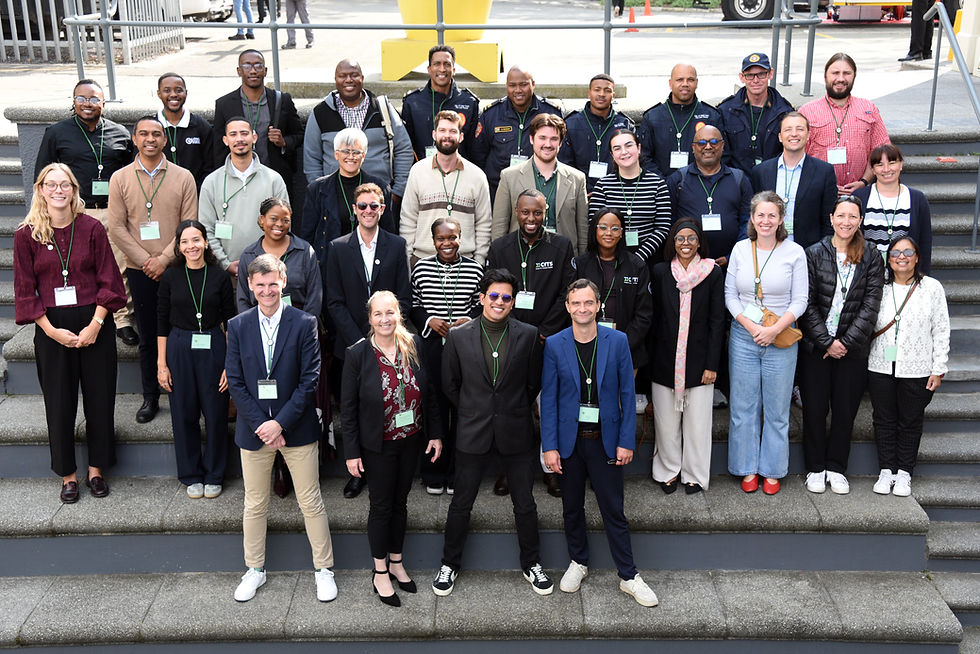
4 August 2026 · Protea Hotel Cape Town Waterfront Breakwater Lodge.
Three years ago, TRANS-SAFE set out with a simple but ambitious premise: that road traffic injuries, one of the most serious and preventable public health challenges facing African cities, could be reduced through evidence, community ownership, gender-responsive design, and sustained political commitment. On 4 August, the project came full circle, closing its journey with a final event in Cape Town that brought together transport professionals, policymakers, researchers, and practitioners from across the TRANS-SAFE network and beyond. Hosted by the University of Cape Town and UITP, the day was built around reflection, taking stock of what the project demonstrated on the ground in Cape Town, Kumasi, Kigali, and Lusaka, and making sure those lessons travel beyond the project's timeframe.
Living Labs: what actually worked on the ground
The morning opened with a round-table on TRANS-SAFE's Living Labs. The demonstration projects that gave the whole approach its credibility. Representatives from each pilot city shared what they implemented and what they learned: Chilekwa O'Brien from Lusaka, Owen Mwaura from Cape Town, Classio Mendiate from Kigali, and Isaac Boateng from Kumasi, moderated by Monica Castañeda of EIT Urban Mobility.
The interventions ranged from low-cost to highly targeted: crowdsourced walkability mapping in Lusaka, geo-integration of high-risk crash locations, small-scale road safety upgrades around school zones, lay-responder training for post-crash care, and digitalised speed recording systems. What came through clearly was that scaling requires the right data, stakeholder engagement and policy adoption.
Designing safety into Bus Rapid Transit
The event hosted a session run jointly with the eBRT2030 project. Speakers walked through how safety gets designed into BRT systems from the ground up. Nathanael Challa presented the Addis Ababa case, Stefano Sirri joined remotely with lessons from Start Romagna in Italy, and Harold Peters spoke to integrating safety into Cape Town's own mature BRT network. The session closed with a segment on post-crash care and rescue from Marianne Vanderschuren and Ondrej Vaculin, before opening into a World Café discussion where participants worked through the practical trade-offs of retrofitting safety into transit systems that are already carrying millions of passengers a day.
Gender as a design question, not an add-on
After lunch, the conversation shifted to how gender shapes exposure to road risk as a design question with direct implications for infrastructure, services, and policy. Nkhensani Biko (UCT), Devon Tighe (Value for Women), and Heba Mousa (ICLEI) presented, moderated by Lottie Steiner of UITP. The discussion moved from women's and men's differing perceptions of safety while walking, waiting, and travelling, to what it actually takes to close that gap on the part of both the public and private sector.
Legacy of the Trans-Safe project
The closing session was the most forward-looking of the day: a reflection on TRANS-SAFE's legacy and the mobility challenges still ahead. Oliver Lah (TUB), Gabriela Straková (UWB), Mikhail Manuel (City of Cape Town), Galeboe Motlhajoe (SORSA), and Luke van Wyk (YOURS) discussed funding, governance, and what it will take to keep the Safe System approach alive after the project's funding ends, moderated by Roland Postma of Young Urbanists.
Road traffic injuries remain one of the most serious and preventable public health challenges facing African cities today. TRANS-SAFE was built on the belief that safer streets require more than infrastructure alone. They require data, community ownership, gender-responsive design, and sustained political commitment. This final event was a chance to take stock of what the project demonstrated, and to make sure those lessons travel well beyond Cape Town. Thank you to everyone who was part of this journey and to those continuing the efforts for safer roads in Africa.


Comments